
Now Reading: Ameenah Gurib-Fakim, The Scientist Who Refused to Leave Africa Behind
-
01
Ameenah Gurib-Fakim, The Scientist Who Refused to Leave Africa Behind
Ameenah Gurib-Fakim, The Scientist Who Refused to Leave Africa Behind

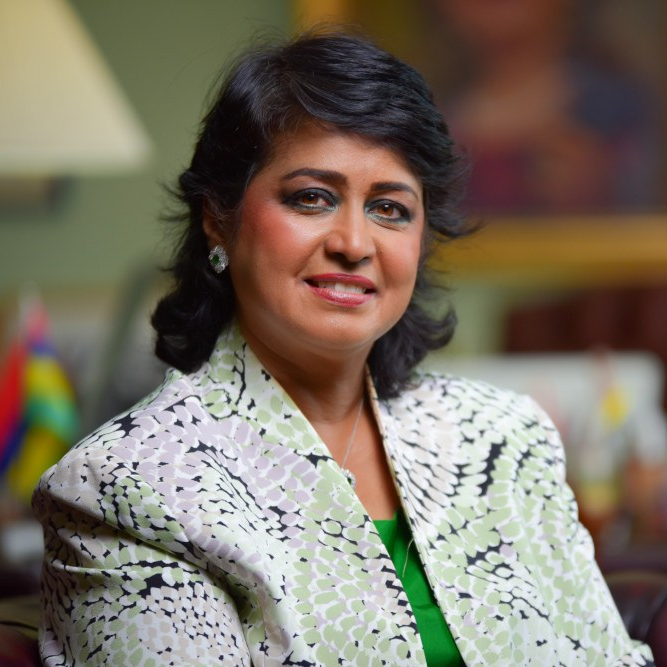
On a quiet morning in Mauritius, long before she would be photographed in state rooms or introduced as a head of state, Ameenah Gurib-Fakim was already listening closely, to plants, to patterns, to knowledge that travelled through hands and mouths rather than textbooks. The work she would later become known for did not begin in laboratories alone. It began in kitchens, forests and conversations where African science was practised but rarely named as such.
Born in 1959 in Surinam, Mauritius, Gurib-Fakim grew up in a country shaped by layered migrations, African, Indian, European and by the ecological abundance of an island where medicinal plants were part of everyday life. She was raised in a household that valued learning and curiosity, but it was her own attentiveness to the natural world that quietly set her apart. At a time when science was still imagined as something imported, she learned early that knowledge could also be indigenous, local and precise.
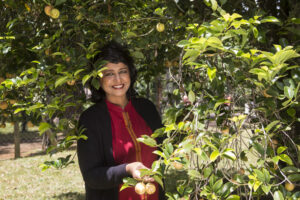
Pamplemousses botanical garden with nutmegs
Her academic journey took her beyond Mauritius, to the United Kingdom and France, where she trained in organic chemistry and pharmacognosy. Yet even as her credentials grew, her intellectual compass remained pointed homeward. She was less interested in leaving Africa than in returning with sharper tools. Her research would focus on medicinal plants used across Africa and the Indian Ocean, not as folklore but as legitimate scientific subjects worthy of rigorous study and global respect.
This decision came with resistance. African scientists, particularly women, were often expected to replicate Western research agendas rather than assert their own. Gurib-Fakim insisted otherwise. She built a career grounded in the scientific validation of traditional medicine, documenting bioactive compounds in plants long used by African communities. Her work challenged a global research ecosystem that had historically extracted knowledge from Africa without credit, protection, or benefit-sharing.
Over decades, she published extensively, collaborated internationally and became a leading voice in biodiversity conservation and bioethics. She served as Managing Director of the Centre for Phytotherapy Research in Mauritius and later as Chair of the African Union’s High-Level Panel on Science, Technology and Innovation. Her advocacy was clear and consistent: Africa’s biological wealth must be studied by Africans, protected by African institutions and leveraged for African development.
In 2015, Gurib-Fakim stepped into a role that surprised even her admirers. She became the first woman President of Mauritius. It was a largely ceremonial post, but symbolically seismic. A scientist, soft-spoken, precise, unflashy, had entered a political space still dominated by spectacle and bravado. She did not attempt to reinvent herself. She brought her full scientific sensibility into public life: measured, evidence-driven and grounded in long-term thinking.
Her presidency was not without controversy. Allegations related to the use of a credit card eventually led to her resignation in 2018, despite her insistence that no personal gain had occurred. The episode was a reminder of how unforgiving public life can be, particularly for women whose legitimacy is constantly under scrutiny. Gurib-Fakim returned, quietly and resolutely, to science and policy advocacy rather than public rebuttal. There was no rebrand, no spectacle, just continuity.
She remains a fierce advocate for women in STEM, particularly in Africa, where structural barriers often begin long before university. She speaks about mentorship not as charity, but as responsibility, an obligation to widen the pipeline and protect intellectual confidence. Her leadership style is collaborative, informed by the scientific principle that progress is cumulative and rarely solitary.
There is a quiet humour in how she describes her career: a scientist who briefly became president and then returned to plants. But beneath that lightness is a serious proposition. Gurib-Fakim’s life challenges the false hierarchy between politics and science, tradition and modernity, Africa and the world. She has shown that African knowledge systems are not relics and that leadership does not have to be loud to be consequential.
Today, she continues to work in global science policy, biodiversity governance and education. Her legacy is not fixed; it is still unfolding, in laboratories, in classrooms, in the confidence of young African women who see in her a different kind of authority. One that listens before it speaks, studies before it declares and understands that the future, like science itself, must be cultivated with care.
Ameenah Gurib-Fakim did not set out to be symbolic, she set out to be rigorous, but in doing so, she became both.










Related Posts


Stay Informed With the Latest & Most Important News
Previous Post
Next Post











Advertisement